There is only one cat breed that can only be black
Published: 2025. 11. 09. 07:30 -
- Photos: Getty Images Hungary • 3 minutes readingPublished: 2025. 11. 09. 07:30 -
- Photos: Getty Images Hungary • 3 minutes reading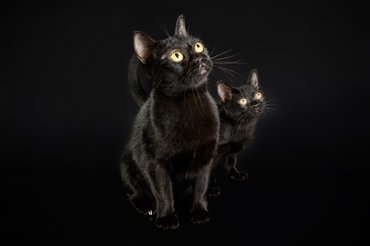
 Set WeloveCatz to appear first in Google search results!
Among the few breeds on our short list, one is still not recognized by any of the major cat breed registries, and it now exists in several shades — though black remains the most common. In our defense — for including it in this collection — the Mandalay cats in their black coats are so stunning and rare that we simply had to show them to you.

Let’s see which cat breed exists only in black.
Salem, the Mandalay:
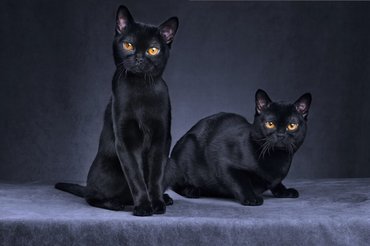
The Bombay breed was created in the 1960s by a breeder named Nikki Horner from Kentucky, USA. Her goal was to develop a unique black cat reminiscent of India’s black leopards, combining the traits of the American Shorthair and the Burmese cat. Horner bred a black American Shorthair male with a Burmese female and, over the years, through careful breeding and selection, she developed her very own “miniature panther.” The result was a short-haired, glossy, close-fitting, jet-black cat with copper eyes. The Bombay was officially registered with the CFA (Cat Fanciers’ Association) in 1970 and achieved championship status in 1976.
According to the CFA standard, adult Bombays must be completely black. Their coat darkens and becomes smoother and shinier as they age. The nose leather and paw pads are also black. Eye color ranges from gold to copper — the deeper and more luminous, the better.
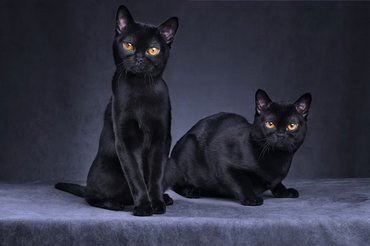
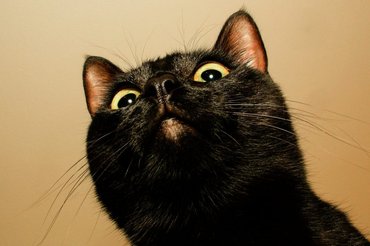
The Mandalay was developed in New Zealand and, like many other breeds, came about through random pairings. The first such pairing occurred on the South Island in the early 1970s, and the second on the North Island in 1988. The South Island breeding program produced kittens from a cream Burmese and a red domestic cat — the kittens all had deep, rich reddish tones. The North Island line began with the crossbreeding of a seal (dark brown) Burmese and a black domestic cat. The resulting kittens were a gleaming, jet-black color with amber eyes. Some breeders fell so deeply in love with these cats that they started breeding programs to reproduce them.
Although the Mandalay is not recognized by any major international cat registry, it is recognized in its homeland by the New Zealand Cat Fancy Inc. since June 1990. Unfortunately, to our knowledge, no cats remain from the two original New Zealand breeding programs. Since then, a “cinnamon Mandalay” program has been developed by introducing the cinnamon gene from Abyssinians and Siamese.
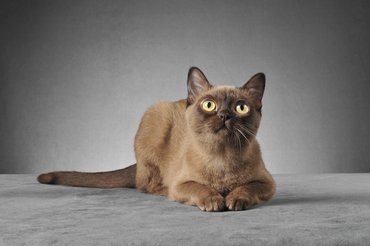
A Burmese (grey) and a Mandalay (black):
Interestingly, under the rules of the New Zealand Cat Fancy Inc., the Mandalay breed can be crossed with the Burmese, meaning that both Burmese and Mandalay kittens may appear in the same litter. The kittens are registered as one breed or the other depending on their color. It’s important to note that the difference between the Mandalay and the Burmese lies primarily — indeed, almost exclusively — in coat color; otherwise, they are identical. Burmese cats carry a gene that modifies coat color (cbcb), while Mandalays do not. A seal Burmese is therefore genetically black, but because of the cbcb gene, its coat appears seal (dark brown).
In simpler terms, the Mandalay’s solid coat color is the result of a recessive gene that eliminates the Burmese shading pattern, producing a rich, even tone. Unlike the Burmese, whose belly tends to be slightly lighter, the Mandalay’s coat color is uniform from head to tail.
Follow us!
facebook instagram
Related articles
7 Reasons Why Cats Arch Their Backs
Life • 4 minutes
How to cut your cat's claws safely
Care • 3 minutes