How Cats Know a Storm Is Coming
Published: 2025. 07. 16. 07:30 -
- Photos: Getty Images Hungary • 3 minutes readingPublished: 2025. 07. 16. 07:30 -
- Photos: Getty Images Hungary • 3 minutes reading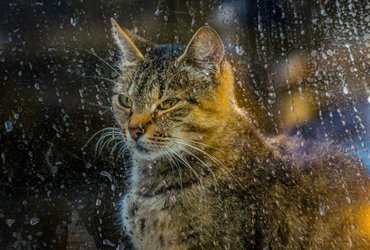
 Set WeloveCatz to appear first in Google search results!
According to historical accounts, sailors kept cats on board not only to take advantage of their fondness for hunting rodents but also because observing the cats could help them predict storms—or at the very least, confirm their own hunches and observations.

And indeed, it's not just an urban legend that cats can sense an approaching storm. Their sensitive bodies and sharp senses provide them with numerous signals when doomsday—okay, fine, a storm—is on its way. Forgive the dramatic wording, but recent weather events seem to justify it.
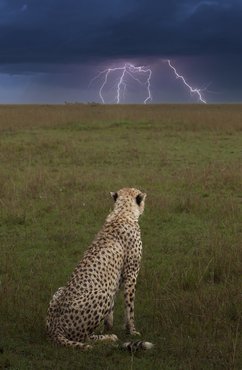
Cats have an extremely sensitive inner ear—much more sensitive than that of humans. It’s not only essential for balance but also acts as a finely tuned barometer. To be precise, the entire inner ear contributes to this perception, but the vestibular system in particular plays a key role in detecting changes in air pressure.
When a storm is approaching, the atmospheric pressure drops quickly. This sudden drop can cause discomfort and lead to noticeable behavioral changes—your cat may become more restless.
Cats have an exceptional sense of smell, roughly 14 times more powerful than ours. Think about how you might have already noticed the scent of rain in the air while sitting outside—the wind can carry the distinctive smell of precipitation from afar. But by the time you look up, you’ll likely see dark clouds gathering. Our feline companions, however, can detect far smaller quantities of scent molecules, and they don’t just pick up the smell of rain—they can also sense the metallic scent of ozone created by lightning.
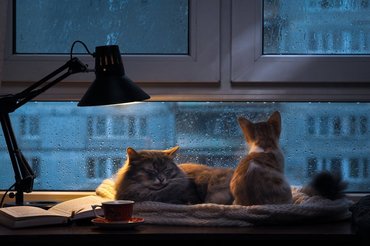
Interestingly, what we perceive as the "smell of rain" is actually a combination of scents: ozone, various organic compounds, and a substance called petrichor, which is released when rain hits dry earth. One of petrichor’s main components is geosmin, an organic compound produced by actinobacteria. The human nose is extremely sensitive to geosmin—and most of us find its scent quite pleasant, likely for evolutionary reasons, as humans have long depended on rainwater.
In addition to their sense of smell, cats also have highly developed hearing (ranging from 48–64,000 Hz), much broader than our own (20–20,000 Hz). This includes the low-frequency rumble of distant thunder, which they can detect from much farther away than we can. This gives them the ability to sense a storm well in advance.
Before it rains, the humidity in the air increases. Cats can sense this change through their skin and fur. Rising humidity can contribute to general restlessness, as the fur becomes heavier or feels stickier when it starts absorbing moisture. Additionally, like human hair, cat fur attracts static electricity, allowing them to feel its increase in the air before a major storm. This is one reason why cats may groom themselves more than usual before a storm.
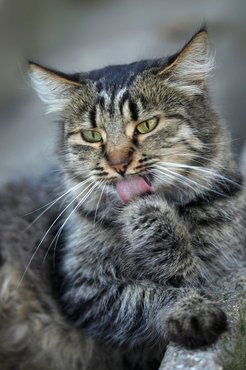
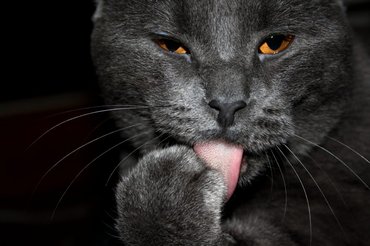
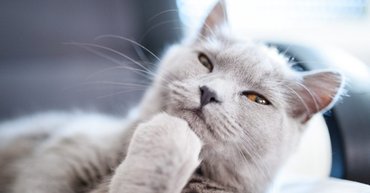
Some cats may become more vigorous in cleaning their fur, paying special attention to the area around their ears. One reason could be to reduce the buildup of static electricity on their fur, or to relieve discomfort in their inner ear caused by the drop in atmospheric pressure.
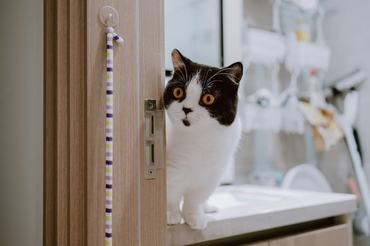
Your cat might become more anxious, pace back and forth, or start meowing for no apparent reason. This behavior may be an attempt to communicate its discomfort or anxiety about the changing weather—especially if your cat is afraid of storms.
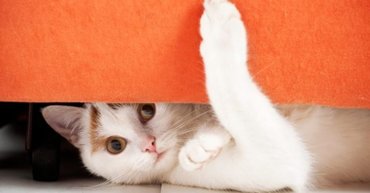
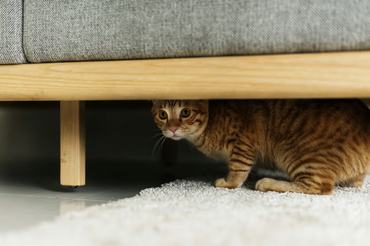
Cats often seek shelter before a storm reaches the area. They retreat to safe, protected spots like under furniture, inside closets, or other hideouts. This is an instinctive defensive behavior meant to help them avoid the discomfort of the incoming bad weather.
Follow us!
facebook instagram
Related articles
7 Reasons Why Cats Arch Their Backs
Life • 4 minutes
How to cut your cat's claws safely
Care • 3 minutes