Cats’ sense of smell is, in some ways, even better than dogs’
Published: 2025. 08. 24. 07:30 -
- Photos: Getty Images Hungary • 3 minutes readingPublished: 2025. 08. 24. 07:30 -
- Photos: Getty Images Hungary • 3 minutes reading
 Set WeloveCatz to appear first in Google search results!
When it comes to dogs’ sense of smell, most people know it’s brilliant – and in many cases, even life-saving. What fewer people realize is that cats also have an excellent nose, which in certain respects works better than a dog’s.

Let’s see how cats’ sense of smell works, and in what ways they outshine man’s best friend.
Like other animals – and humans – cats have traditional scent receptors that detect airborne odor molecules. These receptors are proteins located on the surface of specialized nerve cells that make up the olfactory epithelium (found in the upper part of the nasal cavity). The receptors sit on tiny cilia and are activated when an odor molecule binds to them.
When this happens, the cell sends an electrical signal to the brain – specifically to the olfactory bulb at the front of the brain – where the scent is interpreted. Cats’ olfactory epithelium is proportionally about four times larger than that of humans, allowing them to process scents with greater sensitivity and detail. The number of scent receptors can vary between species and even between individuals.
In addition, our tabby friends have a second “nose” called the Jacobson’s organ, or vomeronasal organ. It’s located in the soft tissues of the nasal septum, just above the hard palate. The visible bump just behind the upper canines is its entrance. Tiny ducts in the palate deliver scent molecules to this organ – through the mouth, not the nasal passages. The receptors in this organ detect not only the pheromones of their own species, but in some cases those of other species as well. The true “superpower” of wild and domestic felines lies in this dual smelling system.
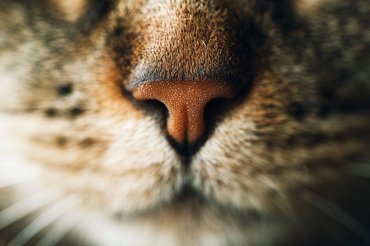
Scientific research into feline olfaction is unfortunately limited, so we don’t know exactly how far away cats can detect a scent. (Certain compounds or smells can be perceived from greater distances than others – true for both humans and animals.) We also don’t know for sure whether some breeds have a stronger sense of smell than others. Scientists estimate, however, that cats can detect the scent of their food from about 38–47 meters away.
What we do know is that based on the amount of olfactory tissue in their noses and the variety of receptor types, this sense is extremely refined. While the human nose has about 5–6 million scent receptors, cats can have up to 200 million. Current theory suggests that cats’ sense of smell is roughly 14 times more sensitive than ours. Moreover, cats are far better at distinguishing between different odors. The receptor responsible for odor discrimination is called the V1R receptor, and researchers have found that while humans have only 2 of these, cats have about 30.
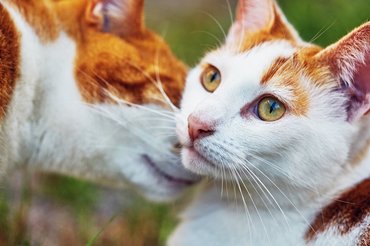
While dogs have about 300 million scent receptors and cats “only” 200 million, cats possess an exceptionally high number of V1R receptors – around 30, compared to a dog’s 9. These receptors are specialized for differentiating between scents.
In conclusion, based on current knowledge, while dogs have a greater overall smelling capacity, cats can detect much subtler differences in odors. This plays a key role in their daily lives – helping them judge the freshness and safety of food, recognize territorial boundaries, detect potential dangers, navigate social interactions with other cats, and compensate for their relatively weaker sense of taste.
Follow us!
facebook instagram
Related articles
7 Reasons Why Cats Arch Their Backs
Life • 4 minutes
How to cut your cat's claws safely
Care • 3 minutes