How Many Words Does an Average Cat Understand?
Published: 2026. 03. 07. 07:30 -
- Photos: Getty Images Hungary, welovecatz.hu • 4 minutes readingPublished: 2026. 03. 07. 07:30 -
- Photos: Getty Images Hungary, welovecatz.hu • 4 minutes reading
 Set WeloveCatz to appear first in Google search results!
A vast number of studies have examined how dogs understand human speech and roughly how many words they are able to learn over the course of their lives. Research on cats is somewhat behind in this area as well, but fortunately we already have some data on the subject.

Below, you can find out how cats resemble infants when it comes to language learning, and—based on our current knowledge—approximately how many words they are capable of understanding.

Cats are able to recognize certain words and respond to them—especially their own names and words that are associated with meaningful experiences for them—but they do not understand human language the way humans do. Instead, they learn words through sound associations and repetition.
Your cat may appear to ignore you when you call her by name, but that does not mean she fails to recognize that you are speaking to her. Researchers and behavior experts agree that cats are aware of human communication—they simply respond on their own terms. “If cats can recognize the names of other cats, there’s no reason they wouldn’t be able to recognize other words as well,” explains cat behavior expert Laura Cassiday to PetMD.
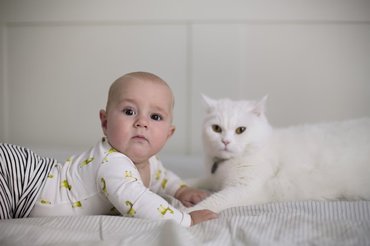
This theory is supported by a study published in 2024, which found that cats learn to associate images with words even faster than babies do. In other words, despite appearances, our cunning companions really are paying attention to what we say. After all, they have lived alongside us in some form for thousands of years, “so it makes sense that they are capable of learning these kinds of associations,” pointed out evolutionary psychologist Brittany Florkiewicz, who was not involved in the research.

The research team gave 31 adult domestic cats a word test originally developed for infants. Scientists seated each cat in front of a laptop and showed them two 9-second animated cartoon images, while their caregivers played recordings in which a made-up word was spoken four times. The nonsense word “keraru” was played while a blue-and-white unicorn that grew and shrank appeared on the screen, and the word “parumo” was played when a red-faced cartoon sun expanded and contracted. The cats watched and listened to these sequences until they lost interest—indicated by a 50% decrease in eye contact with the screen.
After a short break, the researchers played the images four more times. This round, however, included a twist: half of the images were paired with the “wrong” audio—the sun with “keraru” and the unicorn with “parumo.” The cats appeared visibly confused and spent, on average, 33% more time looking at the screen when they heard the mismatched pairing. According to the study’s lead author, Saho Takagi, this suggests that they had learned the original word-image association.

Surprisingly, the vast majority of the cats learned the association after just two 9-second “lessons.” In contrast, most 14-month-old human infants require four 15-second sessions, during which they hear each word seven times per lesson rather than four. “Cats pay more attention to what we say in everyday life and try harder to understand us than we might think. Importantly, they seem to acquire these word-image associations without special training or an explicit promise of reward—similar to the way infants learn language,” Takagi points out.
However, it is important to note that these findings do not necessarily mean that human babies learn words more slowly than cats, warns developmental psychologist Janet Werker of the University of British Columbia. Although the cat test was modeled on a study developed for infants in the late 1990s, significant methodological differences remained. In Takagi’s study, for example, the cats heard three-syllable words spoken in an exaggerated speech style by their own caregivers; by contrast, the babies heard one-syllable words with varying intonation spoken by unfamiliar voices.

Unlike with dogs, there is no clear research determining the maximum number of words a cat can learn. According to Laura Cassiday, she has had cats that knew 10–15 cue words, but based on our own experiences, this number is likely much higher—especially if we include everyday expressions used in a household that the cat associates with significant positive or negative experiences, rather than just formal command words.
Because cats learn words by associating sounds with experiences—not by understanding definitions—there are no strict rules about which words they can or cannot learn. If you are consistent in your training, you can attach a word to almost any activity. “They are very sensitive to cues that predict something is about to happen. For example, if you regularly say a word before doing something important to them—such as feeding them or giving them medication—they will learn it,” Cassiday explains.
The cat behavior expert suggests avoiding negative cues like “no” or “stop,” as these may be too complex for cats. Instead, it may be more effective to teach a cue like “down” or “off the floor” if you do not want your cat on the table. Your body language also matters, as does how you say the word—your emphasis and intonation play an important role.
Follow us!
facebook instagram
Related articles




7 Reasons Why Cats Arch Their Backs
Life • 4 minutes
How to cut your cat's claws safely
Care • 3 minutes