It Has Been Revealed Which Animals Cats Eat the Most
Published: 2026. 02. 16. 07:30 -
- Photos: Getty Images Hungary • 3 minutes readingPublished: 2026. 02. 16. 07:30 -
- Photos: Getty Images Hungary • 3 minutes reading
 Set WeloveCatz to appear first in Google search results!
Since their domestication, cats have spread to virtually every corner of the Earth, settling on all continents except Antarctica. As a result, they have become one of the most widespread species on the planet—though their presence has not been without consequences.

You might not realize it, but our feline companions have a significant impact on the environment. They indirectly spread diseases that can also be dangerous to humans and compete with native predators, which is why they are considered an invasive species in many regions. This competition extends not only to resources but also to mating opportunities. In Hungary, for example, domestic cats pose a serious threat to local wildcat populations through hybridization. As much as we love cats, it unfortunately seems true that they are among the most problematic species on Earth. That said, it is also part of the truth that humans are responsible for this situation. As the Fox says in The Little Prince: “You become responsible, forever, for what you have tamed.”

Although numerous extensive studies had already been conducted, until 2023 there was no comprehensive global documentation of the species consumed by cats. A study by Christopher A. Lepczyk and his team filled this gap by creating the largest cat diet database to date, based on more than 500 publications.
The researchers examined the diet of free-ranging domestic cats—that is, owned cats allowed outdoors as well as unowned cats—taking into account factors such as prey species, island or continental location, conservation status, and body mass. The results showed that out of the 2,084 species consumed by cats, 347 are listed on the International Union for Conservation of Nature (IUCN) Red List as “Near Threatened” or in a higher risk category. The study highlights that the consumption of threatened species is more frequent on islands than on continents, indicating that different cat populations have distinct geographical impacts.

Cats are opportunistic predators and obligate carnivores. Remarkably, they can survive for long periods relying solely on the water naturally present in their prey. The study also found that their diet is not limited to a single type of prey; this dietary diversity contributes to their ability to survive in a wide range of ecosystems.
Globally, birds make up the most frequently preyed-upon group. However, the presence of other prey types—such as mammals and reptiles—varies by location, demonstrating these predators’ ability to adapt to locally available prey. According to the study, cats consume 981 bird species, 463 reptile species, 431 mammal species, 110 insect species, and 57 amphibian species. They are also indiscriminate when it comes to prey size. Since they show no clear preference in this regard either, researchers suggest this further underscores their versatility, as they can adapt their hunting strategies to different environmental conditions.
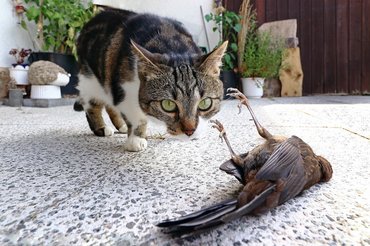
From the data, one clear conclusion can be drawn: cats attack and consume virtually anything they consider catchable prey at a given time and place. As previously noted, this behavior reflects an extraordinary level of adaptability, but it is also concerning from a conservation perspective. At the same time, understanding this behavior offers hope, as it increases the chances of developing strategies to protect vulnerable and endangered prey species.
As a responsible owner, you can help by keeping your cat indoors or allowing outdoor access only under controlled conditions. This not only protects wildlife in your environment but also safeguards your cat, reducing the risk of accidents, conflicts, and disease. Indoor living also helps prevent unnecessary reproduction, meaning you are not contributing further to the stray cat population, which already numbers in the millions.
Follow us!
facebook instagram
Related articles




7 Reasons Why Cats Arch Their Backs
Life • 4 minutes
How to cut your cat's claws safely
Care • 3 minutes