9 Interesting Facts About a Cat’s Whiskers: They Can Move Them Consciously—and They Even Have Them on Their Legs
Published: 2026. 02. 09. 07:30 -
- Photos: Getty Images Hungary • 4 minutes readingPublished: 2026. 02. 09. 07:30 -
- Photos: Getty Images Hungary • 4 minutes reading
 Set WeloveCatz to appear first in Google search results!
Our pets’ cutest accessories hide many secrets. You might not even realize how complex a sensory system they are!

Here are 9 interesting facts about a cat’s whiskers.
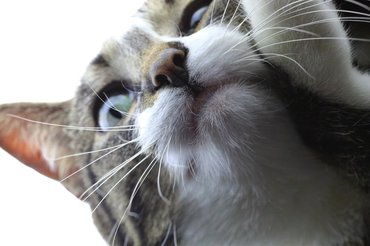
Whiskers, also known as vibrissae, are made of keratin just like hair, fur, and nails, but they are thicker than ordinary hairs. A cat’s whisker is not merely a hair—it is actually a sensory organ. Each whisker grows from a strong follicle surrounded by numerous nerve endings, allowing it to detect even the tiniest vibrations. Whiskers are embedded deeper in the skin, and the nerves transmit signals directly to the brain, enabling cats to perceive their surroundings precisely, even in complete darkness. This is why whiskers play a crucial role in spatial awareness, hunting, and balance.
Although cats’ eyes are well adapted to low-light and dim conditions, their whiskers give them an extra advantage. In poor lighting, vibrissae help them sense the shape, size, and movement of nearby objects. By detecting subtle changes in air currents, cats can avoid obstacles, sneak up on prey, or even jump onto narrow, elevated surfaces. It’s almost as if they have an invisible radar built into their faces.

A cat’s whiskers are extremely sensitive. If a cat has to eat or drink from a narrow bowl, the pressure on the whiskers can cause what’s known as whisker stress (or whisker fatigue). If your cat scoops food out with its paw or leaves food near the edges of the bowl untouched, it’s worth switching to a wider, shallower dish.
As mentioned earlier, whiskers are essential for a cat’s balance, spatial orientation, and sense of direction. Cutting them can cause serious disadvantages and increased stress. Accidents can happen, though—a cat may lose whiskers, or someone might accidentally trim them while grooming. Don’t panic in such cases! Cutting whiskers does not cause pain, as they do not contain pain-transmitting nerves. Under normal circumstances, vibrissae grow back within 6–12 weeks.

Most cats have 24 whiskers: 12 on each side of the face, usually arranged in four perfectly parallel rows with three whiskers per row. Of course, individual variation exists. In certain breeds—such as hairless cats or short-haired Cornish and Devon Rex cats with single-layer coats—the absence of whiskers is not uncommon. In other cases, whiskers may be short, curly, weaker, and more fragile.
Cats don’t just shed their fur or renew their claws—their whiskers also fall out and are replaced by new ones. Normally, they lose no more than one or two whiskers at a time. However, excessive whisker loss may indicate high stress levels, feline acne, bacterial or fungal infections, or allergies. In such cases, consulting a veterinarian is strongly recommended, as significant whisker loss can be a symptom of a more serious condition.
Whiskers act as an excellent measuring tool, helping cats determine whether they can fit through an opening. It’s a widely accepted fact that if a cat’s head fits, its body will follow—provided the cat is not overweight.
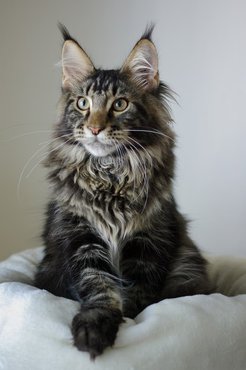
Generally, the denser or fluffier a cat’s fur, the longer its whiskers tend to be. A Maine Coon—the largest domestic cat breed—can have whiskers up to 15 cm long. As mentioned earlier, hairless or very short- and sparse-haired breeds may have missing or incomplete whiskers. The world record for the longest whiskers belongs to a Finnish Maine Coon named Fullmoon’s Miss American Pie: Missi boasted vibrissae measuring an impressive 19 cm.

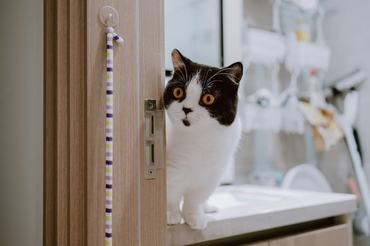
Vibrissae are connected to muscles, allowing cats to move them independently and voluntarily. Whisker position is also an excellent indicator of mood, much like ear or tail posture. When a cat is relaxed, its whiskers rest loosely and extend sideways. When alert or curious, the whiskers point forward. When frightened or angry, a cat may press its whiskers tightly against its face.
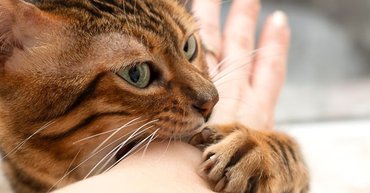
Sensory hairs (vibrissae) can also be found above the eyes, in the eyebrow area, and on the back of the front legs. These so-called “leg whiskers” are extremely helpful for sensing prey and objects beneath them, especially while climbing.

Follow us!
facebook instagram
Related articles

7 Reasons Why Cats Arch Their Backs
Life • 4 minutes
How to cut your cat's claws safely
Care • 3 minutes